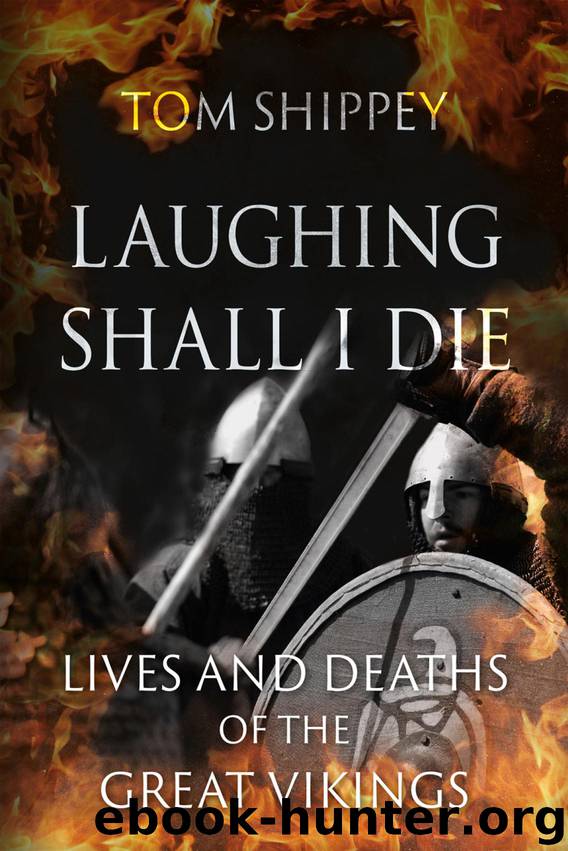
Laughing Shall I Die: Lives and Deaths of the Great Vikings by Shippey Tom
Author:Shippey, Tom [Shippey, Tom]
Language: eng
Format: mobi, epub
Publisher: Reaktion Books
Published: 2018-06-28T16:00:00+00:00
furu trikila fiari at kuli
[They] fared like bold men far for gold
ok a:ustarla arni kafu
and in the east gave [food] to the eagle,
tuu sunar:la at sirk:lan:ti:
died in the south in Sirkland17
It is a famous, almost emblematic statement of the Viking urge (the British Museum exhibition ‘Vikings: Life and Legend’, 2014, quoted it prominently, but silently cut out the word trikila (drengiligr), ‘like bold men’ – not the preferred image in scholarly circles). But what was meant by ‘Sirkland’? Could that be Sarkland, the place where people wear ‘sarks’ (shirts), that is, robes, not trousers? Or could it be ‘the land of silk’, from Latin sericum?
Or could it be ‘Forty-land’? The Russian word for the number forty is sorok, but the word is ‘completely anomalous in the Russian numerals system’. Andrew Jameson claims that it ‘almost certainly denotes the number of small furry animal skins demanded as tribute by the Vikings as they travelled along the Russian river system on their way to and from the Black Sea’, perhaps from each household from which they took protection money.18 The Primary Chronicle notes (just after its description of saunas) that the Khazars imposed a tribute of a white squirrel skin on each hearth of their tributaries, while Oleg the Varangian charged ‘a black marten-skin apiece’.19
Rarity furs clearly had special value. One Arabic commentator says that a black fox-skin went in Baghdad for 100 dinars,20 though the amount is hardly credible: a dinar was a gold coin, heavier than a silver dirham, and worth maybe twenty times as much. Would it have sold for 2,000 dirhams? Dirhams were heavier than pennies, so maybe 3,000 silver pennies, 5.5 kg (12 lb) or more in weight? For one skin? Even a fraction of that would have made the fur trade the Dark Age equivalent of the trade in cocaine today. We know, however, that many thousands of dirhams did indeed fetch up in Gotland.
These are speculations, but the Russian Primary Chronicle does give a coherent account and time frame for the arrival and consolidation of the Rus.21 According to this twelfth-century writer (using earlier written sources and writing in Old Church Slavonic), the story began with three brothers called Rurik, Sineus and Truvor (i.e. Hrærekr, Signjötr and Þorvarðr). There seems to have been a prehistory, as suggested above, for according to the chronicler the native inhabitants first drove out the ‘Varangians’, but then, finding themselves incapable of self-rule, in the early 860s invited the three brothers to come in from overseas. Rurik established himself at Novgorod, near Lake Ilmen, and soon took over his brothers’ cities also – in the process founding a dynasty, the ‘Rurikids’, which held rule in Ukraine and Russia until 1598.
Meanwhile, two other men, Askold and Dir (Höskuldr, Dýri), took over Kiev and from it launched the first of several unsuccessful attacks on what the Primary Chronicle calls ‘Tsargrad’, Constantinople. Before he died, Rurik bequeathed the care of his infant son Igor to a relative called Oleg, and Oleg eliminated Askold and Dir.
Download
Laughing Shall I Die: Lives and Deaths of the Great Vikings by Shippey Tom.epub
This site does not store any files on its server. We only index and link to content provided by other sites. Please contact the content providers to delete copyright contents if any and email us, we'll remove relevant links or contents immediately.
| African | Asian |
| Australian & Oceanian | Canadian |
| Caribbean & Latin American | European |
| Jewish | Middle Eastern |
| Russian | United States |
4 3 2 1: A Novel by Paul Auster(12357)
The handmaid's tale by Margaret Atwood(7732)
Giovanni's Room by James Baldwin(7305)
Asking the Right Questions: A Guide to Critical Thinking by M. Neil Browne & Stuart M. Keeley(5743)
Big Magic: Creative Living Beyond Fear by Elizabeth Gilbert(5730)
Ego Is the Enemy by Ryan Holiday(5395)
The Body: A Guide for Occupants by Bill Bryson(5066)
On Writing A Memoir of the Craft by Stephen King(4921)
Ken Follett - World without end by Ken Follett(4708)
Adulting by Kelly Williams Brown(4555)
Bluets by Maggie Nelson(4535)
Eat That Frog! by Brian Tracy(4502)
Guilty Pleasures by Laurell K Hamilton(4428)
The Poetry of Pablo Neruda by Pablo Neruda(4082)
Alive: The Story of the Andes Survivors by Piers Paul Read(4011)
White Noise - A Novel by Don DeLillo(3993)
Fingerprints of the Gods by Graham Hancock(3980)
The Book of Joy by Dalai Lama(3962)
The Bookshop by Penelope Fitzgerald(3829)
